The Danish language in elderly care

The Danish language in elderly care

The Danish language in elderly care

Sangita runs the brush through the fine white hair in long, gentle strokes. The elderly woman lights up, as if each stroke brings out another smile. While Sangita makes her look nice, stories about the granddaughter begin to surface.

“I love when the residents open their hearts,” Sangita says.

In the summer of 2025, she started working at a care home in Copenhagen without a formal Danish care qualification. It was an important first step into the job market, with Danish as her working language.

When she first walked into the care home, she had already studied Danish at UCplus for two years. But the language used in elderly care is something special, and it took time to get used to.

What she did know was how to care. And through that, conversations slowly opened up.

Anna kursist

A dream of a life in Denmark

Sangita is 33 and a trained pharmacist from Nepal, where she spent six years working at a hospital. She arrived in Denmark in 2022 and started with regular Danish classes. Since early 2025, she has been attending FVU Health Danish.

Sangita plans to stay in Denmark for many years. Alongside her Danish studies and her job at the care home, she also works full-time in the restaurant industry.

“It’s important for me to learn the language and become part of society,” she says.

In FVU Health Danish, she and the other students learn the spoken and written language used in social and health care work and in healthcare education programs.

Anna kursist

As part of the teaching, external guest speakers are invited. Most recently, three doctors from Sund Start visited and talked about the Danish healthcare system.

Study visit gave job and confidence

As part of the course, the Health Danish class visited a care home in Copenhagen. They spoke with the manager and were given a tour. Afterwards, two students decided to become volunteer visiting friends. Sangita was offered paid employment at the care home.

Being somewhere where people can’t simply switch to English has been challenging, but it has also developed her Danish:

“In the beginning, it was difficult to understand the elderly if they spoke quietly or mumbled. It made me insecure, and I didn’t like asking them to repeat themselves. But it’s much better now,” Sangita says.

From being “the new one,” standing behind the experienced staff, she has become a visible part of the care home:

“Now all the residents on the 3rd and 4th floors know me. They call me sweetheart and ask when I’m coming back to work. It means so much to me. I’m proud that I make a difference for them, and that they trust me,” she says.

From Health Danish to SOSU

Sangita is currently on level two of four, and she is determined to finish Health Danish for a very special reason: she wants to train as a social and health care helper.

Anna kursist

On 7 October, the Health Danish class visited the Open House event at SOSU H to hear about their options.

At the event, Sangita learned that she can receive credit for several subjects. She will start when she has completed her Danish course, which is a requirement for enrolling in the programme.

It won’t be long before all those hours of Danish are tested in a new classroom, where everything takes place in Danish.

Sangita feels more ready than ever, largely because she has used the language and the technical terms in practice:

“There are many assistive devices in elderly care, so vocabulary is important. Now I can remember words like magnifying glass and wheelchair much better, because I’ve used them at the care home – not just seen them in a textbook,” Sangita concludes.

Want to work in healthcare, but need Danish?

In FVU Health Danish, you learn professional vocabulary, spoken communication and written Danish used in social and health care work, at care homes and in healthcare education.

The course is free and aimed at adults who work – or would like to work – in the healthcare sector.

Read more and sign up here: https://ucplusdansk.dk/fvu-sundhedsdansk/

Fast Track to Danish at Work

Fast Track to Danish at Work

Fast Track to Danish at Work

The textbook Sådan 1 gives newly arrived foreigners the vocabulary, ready-to-use lines, and confidence to dive into Danish at work and in everyday life. The book’s author is a language consultant at UCplus Copenhagen.

Anna kursist

Small talk like “What are your plans for the weekend?” or “Where do you live?” is essential when you start at a new workplace in Denmark—but it can be tricky for newcomers. The textbook Sådan 1. Beginner’s Danish for Foreigners helps learners quickly use Danish in the situations they meet at work and in everyday life. The book’s author is a language consultant at UCplus Copenhagen.

“Many of our newly arrived course participants are already working and have busy lives, so they need to learn functional Danish quickly and effectively. With Sådan 1, learners get a toolbox with pronunciation exercises, useful vocabulary and practical grammar they can put to use immediately,” says language consultant Frank Sebastian Hansen, author of Sådan 1 and a language consultant at UCplus Copenhagen. He has just returned to Denmark and to UCplus after four years as a Visiting Lecturer in Danish at the University of Texas in Austin, USA.

Rapid progression

Sådan 1 is designed for beginners at the language centres’ Danish Education 3. The book consists of 21 chapters on everyday topics such as family, work and education. Each chapter is organised into clear “universes” with familiar exercise types and structures.

“Everything is in a fixed place, so learners quickly feel comfortable with the material and can spend their energy on using the language in the right context. The clear structure allows for fast progression in teaching,” explains Frank Sebastian Hansen. The book also includes set dialogue formats and partner activities that get learners speaking in class—and encourages them to go out and practise at work. “The book unites the best of two worlds: a tight structure and plenty of opportunities to talk and develop language in practice,” says the author, who holds an MA in Danish and has previously taught at, among others, Studieskolen and KISS.

Anna kursist

A strong fit for online and university classes

Frank Sebastian Hansen co-wrote Sådan 1 with Einar Helleland. Together they have published a handful of other textbooks, including the follow-up classic Så kan du lære det for learners on Danish Education 3. At UCplus Copenhagen, these books are a core part of our classroom materials, says Deputy Head and Pedagogical Lead Jakob Bang Termansen.

“We use Sådan 1 in our online and university classes, where it helps learners make fast progress with their Danish skills. The books are well-crafted and built on functional Danish,” says Jakob Bang Termansen, adding that it’s a major advantage to have textbook authors in-house: direct access to the source when questions arise, and a writing process that includes sparring with colleagues and testing materials with classes—spreading insights across many teachers.

There is also a Sådan 2, and a revised edition of Sådan 1 is on the way—expected in spring 2026.

From first steps in Danish to new opportunities

From first steps in Danish to new opportunities

From first steps in Danish to new opportunities

Sofia from Italy and Katrin from Germany arrived in Denmark for very different reasons – yet both found their way through Danish lessons at UCplus and share the same goal of building a good life in Copenhagen.

Anna kursist
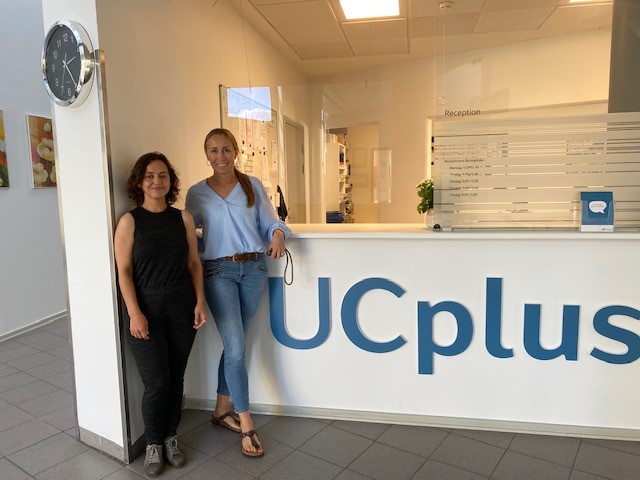
Sofia and Katrin on their way to Danish lessons at UCplus in Copenhagen. The classes have provided them with language skills as well as new opportunities in Denmark.

Starting over in a new country takes both courage and curiosity. For Sofia, a quick internet search after a stay in New Zealand led her to book a ticket to Copenhagen. Katrin, on the other hand, came as an accompanying spouse when her husband was offered a position at ITU. While Sofia quickly created a new life from scratch, Katrin has been taking her first steps towards continuing her career in the Danish healthcare sector.

Sofia’s spontaneous start in Denmark

After finishing her university degree in Italy, Sofia knew she wanted to try something completely new. When her stay in New Zealand came to an end, she began looking for countries that could offer a similar lifestyle – and Denmark appeared on her screen. Without speaking the language or knowing anyone here, she booked a 10-day trip to Copenhagen.

“The moment I stepped out of the central station and saw all the bicycles, I just knew this was the place for me,” she recalls.

On her very first day in the city, she walked into a barefoot shoe shop she was fond of. Two days later, the owner called her back with a job offer. A quick trip to Italy to pick up more clothes – and her new life in Denmark had begun.

For the first six months she tried to teach herself Danish with a book, but soon realised she wanted to meet others who were learning the language as well. That led her to UCplus. Today she has completed Module 4 and recently landed a job as a nursery assistant – a position she won among 74 applicants, with a glowing reference from her UCplus teacher.

Katrin’s first steps towards a career in Denmark

Katrin moved to Copenhagen in April 2024 as a trailing spouse, when her husband started working at ITU. Back in Cologne, she worked as a diabetes consultant at a medical clinic, and she hopes to eventually continue her career in the Danish healthcare sector.

For now, she is focusing on improving her Danish at UCplus and building a network in her new neighbourhood. Through Sofia, she got a part-time job at the same barefoot shoe shop where Sofia first worked in Copenhagen. It gives her the chance to practice Danish in daily situations and connect with new people in Ørestad, where she and her family live.

“It’s important for me to learn Danish because I want to integrate into the country. I want to be able to speak Danish with my son, and I hope to find a job in the healthcare sector,” says Katrin.

Language as a stepping stone

For Sofia, learning Danish has opened the door to an entirely new line of work. For Katrin, it is the foundation she needs to return to her profession in a new country. Both

highlight how the Danish lessons give them the confidence to use the language in real-life situations – whether that’s at a playground, in a shop or during a job interview.

Learn Danish at UCplus

UCplus offers the three official Danish courses, which give you access to official tests and a good start in Denmark. The education is offered at 3 levels, each of which consists of 6 modules. You will be offered to start at exactly the level that suits the number of years of schooling you have and your qualifications.

Read more and sign up here

New language centre director brings extensive experience in Danish language teaching and integration

New language centre director brings extensive experience in Danish language teaching and integration

New language centre director brings extensive experience in Danish language teaching and integration

From teenage dreams of becoming a medieval archaeologist to leading a language centre – life has taken an unexpected yet rewarding turn for Lilian Olsen, who stepped into the role of manager at UCplus’ language centre in Holbæk on 1 August. With decades of experience in Danish language education and integration, she brings both solid professional expertise and a deep personal commitment to the job.
Anna kursist

Driven by people’s potential

Since the mid-1990s, Lilian Olsen has been teaching Danish to newcomers, motivated by a genuine curiosity about her students’ backgrounds and their potential. For her, teaching Danish is about far more than words and grammar – it is about giving people the tools they need to take part fully in Danish society.

Even in a time when artificial intelligence is evolving rapidly and English is widely used in the workplace, she believes Danish remains the key to deeper integration. It is about being able to read letters from the authorities, take part in parent–teacher meetings, talk with in-laws, or start a conversation with a neighbour. Language is also the gateway to Danish culture – including its humour, wordplay, and shared references.

A career spanning local and global experience

Lilian’s path into language and integration work began with a master’s degree in history and Arabic in 1995, followed by a temporary position at Copenhagen Language Centre and then a role at the Danish Refugee Council’s language school. Her career took her abroad through postings with the Danish Ministry of Foreign Affairs to the USA, Uganda, and Niger, where she worked on microcredit projects and school initiatives.

Back in Denmark, she continued her work in the language centre sector as a teacher, module tester, examiner, intake assessor, and project coordinator. She has also taught quota refugees in Asia and Africa as part of the Danish Immigration Service’s pre-departure courses.

Since 2022, she has been part of SIRI’s mobile assessment team and most recently worked as coordinator for substitute teacher coverage and intake at UCplus in Copenhagen.

Committed to collaboration and the right learning environment

Lilian brings to Holbæk a wealth of experience from teaching, intake assessment, coordination, and project management – both in Denmark and internationally. She looks forward to using this broad background to create the best possible environment for both students and teachers. Collaboration with the municipalities of Holbæk and Odsherred will be a key part of her work, with the ambition of making the language centre a strong and visible presence in the local community.

Read more about UCplus Language Centre Holbæk

Danish lessons help international employees at Landal Holiday Park

Danish lessons help international employees at Landal Holiday Park

Danish lessons help international employees at Landal Holiday Park

At Landal Holiday Park in Søhøjlandet, the management has introduced Danish lessons for the cleaning team, aiming to strengthen daily communication and build a genuine sense of community among the staff. The goal has been to create a solid foundation for teamwork, wellbeing, and staff retention, with language as the key.

Anna kursist

The international staff in the cleaning team at Landal Holiday Park are learning Danish at work to improve their communication the sense of community.

Language improves team spirit and efficiency

When Kirstine Bruun took over as head of the cleaning team three years ago, she quickly recognised the need to bring the team closer together. Having previously worked with international employees in agriculture, she knew how crucial language is to creating a well-functioning team. So, she arranged for Danish lessons during working hours—and everyone agreed to take part.

“I wanted to create a ‘third culture’—a shared workplace culture where we could truly understand one another through language,” Kirstine explains.

It has proved to be a worthwhile investment. The Danish lessons have enabled staff to become more independent, take on greater responsibility, and engage more confidently in their work.

Kirstine herself plays an active role in supporting staff language development. In her office, she keeps a basket filled with useful Danish words relevant to the team’s work.

When new employees join, they each pick out two new words every day—words like ‘gulvmoppe’ (floor mop) or ‘køkkenbord’ (kitchen table).

“This helps them build their vocabulary day by day. It also shows we value them by investing in their development, and it boosts their confidence in speaking Danish,” Kirstine adds.

Lessons focused on Danish Society and workplace culture

The Danish course at Landal is part of an FVU Start programme, taught by UCplus language consultant Sussi Brøndum Riise. Lessons are built around the participants’ daily lives and experiences, both at work and as residents in Denmark. For example, they discuss Danish public holidays like Constitution Day and explore what it means to live in a democracy.

Grammar is practised to help participants speak clearly and accurately, while conversation exercises ensure they can put the language into use in practical situations. They discuss how to communicate effectively in a Danish workplace, the importance of greeting colleagues each day, and who to approach when in doubt.

These lessons provide a safe environment for employees to grow in confidence while gaining insight into how Danish workplace culture operates—making everyday life easier and more secure.

Building confidence and community

Polina from Bulgaria, who has lived in Denmark for over seven years, says the Danish lessons have made a real difference: “Each week I feel a little more confident because I understand more and more. It’s important for me to speak Danish because I live and work here—and I need to be able to talk with teachers and childminders.”

Anastasiia from Ukraine adds: “Learning the language helps me communicate better with my colleagues, and that makes life easier. I understand more than I can say, but I keep trying, and my colleagues help me.”

Staff—new and experienced alike—now share lunch together, chatting in Danish and supporting each other in their learning. Danish has become a shared project and a tool for both professional and social development.

Help your international employees learn Danish

UCplus offers a range of flexible solutions for company Danish. Lessons can take place at the workplace, at the nearest language center, or through online instruction.

UCplus handles all coordination and provides skilled instructors who conduct Danish lessons at the employees’ level.

It is possible to apply for lost earnings if the lessons are held during working hours. UCplus also helps with the application process.

Read more here

Cookies